Press Release
Museo Nivola presents Blue Blooded, the first solo exhibition in Italy by Hannah Levy. Curated by Giuliana Altea, Antonella Camarda, and Luca Cheri, the exhibition brings together a group of new sculptures inspired by the horseshoe crab, or limulus: an uncanny-

International ongoing exhibitions
Hannah Levy, Blue Blooded
Museo Nivola, Orani (Italy)
28.03 - 12.07.2026

Levy’ sculptures combine polished metal with translucent silicone and glass, generating sinuous forms that—choing a Surrealist-
The central work of the exhibition is a large tentacular structure in stainless steel and silicone. It resembles a light canopy supported by long, slender legs. Its proportions echo those of the museum space and its silhouette suggests at once a beach shelter and a fossilized skeleton on display in a natural history museum. The stretched spiny shell-
Alongside this installation, are a series of glass sculptures supported by sharp metallic claws. These creature-
Another work consists of aluminium shells cast from the spiny exterior of the horseshoe crab, with long exaggerated and imposing sculptural tails. Atop these alien creatures, one shell sits overturned and filled with cast blue glass revealing the anatomy of the crab’ underbelly. Crafted through a traditional lost wax process, these objects combine various ancient artisanal practices with a vaguely prehistoric imagination. On the walls, stainless steel elements resembling pincers are installed like organically shaped sconces: each set of claws grips a misshapen orb of blown blue glass, imbuing the ensemble with an ambiguous, faintly disquieting sensuality.
In the exhibition, the horseshoe crab functions as an ideal fulcrum: a presence that orients every work, even when not immediately recognizable.
At once archaic and strikingly contemporary, the horseshoe crab is as compelling visually as it is symbolically. Often described as a “iving fossil,”it has remained almost unchanged since the Triassic era and bears within its body an imprint of Prehistory. Its vividly blue blood contains Limulus Amebocyte Lysate (LAL), a substance essential for detecting bacterial contamination in pharmaceutical products. Each year thousands of specimens are captured, bled, and returned to the sea in a process that has raised growing ethical and environmental concerns. While still vital to medicine in the US (in the European Union a synthetic substitute was approved in 2020), this practice prompts urgent questions about the moral limits of exploiting natural resources and about human responsibility toward species on which our own survival depends.
The project developed in direct dialogue with the museum’ exhibition space—he former washhouse of Orani—nd with the figure of Costantino Nivola. The long, narrow nave, the gabled roof with exposed beams resembling ribs, and the building’ strong architectural identity became the exhibition’ point of departure. While researching for the exhibition, Levy unearthed an extraordinary connection with Nivola: she became aware that it was while playing with his children on the beach at Springs, Long Island, that the sculptor first experimented with his signature sandcasting technique. It was along that very same coastline that Levy collected the many horseshoe crab specimens that form the conceptual matrix of the show.
Like Nivola, Levy explores the boundary between art and architecture and conceives sculpture as a spatial and public experience. The rectangular volume and structural clarity of the space offer a counterpoint to the sculptures’curved, pulsating lines. Within this essential environment, the works are arranged like living presences that place rigidity and softness, the natural and the artificial, into tension, transforming the architecture into a resonant chamber for the ethical questions and sensory impressions generated by the exhibition.
Blue Blooded reveals Hannah Levy’ ability to construct sculptural universes in which technology and nature intertwine. The exhibition proposes a reflection on the fragility of the systems that sustain contemporary life, and on the need to rethink our relationship with the living world.
Hannah Levy (born 1991 in New York, where she lives and works) creates sculptures and installations that investigate relationships between the body, desire, and materiality. Her work combines industrial materials—articularly polished metal—ith elements such as silicone and glass to create forms that evoke animal and vegetal anatomies as well as design objects. She participated in the 59th Venice Biennale, The Milk of Dreams (2022), and has exhibited at major international institutions and galleries. Her works are held in public and private collections and have been presented in numerous solo and group exhibitions.
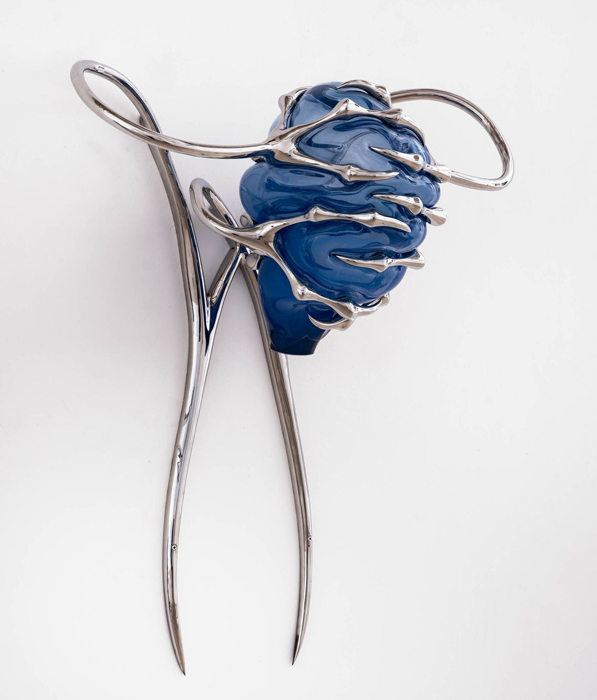
Hannah Levy, Untitled, 2025. Stainless steel, glass, 31 ×37 ×16 inches. Courtesy of the artist and MASSIMODECARLO. Photo: Adam Reich.
Exhibition 23 April -

© ArtCatalyse International / Marika Prévosto 2025 All Rights Reserved