Press Release
Harwood Museum of Art and Fort Garland Museum & Cultural Center present Unearthing Futures / Desenterrando Futuros.
Unearthing Futures / Desenterrando Futuros explores adobe as a living practice linking art, architecture, and ancestral knowledge across the Americas. Bringing together artists Gabriel Chaile, rafa esparza, Santino Gonzales, Joanna Keane Lopez, Ronald Rael, and Christine Howard Sandoval, the exhibition examines how earth, water, and fiber, shaped by hand and sustained through communal care, embody both tradition and transformation.

International ongoing exhibitions
Unearthing Futures
Harwood Museum of Art, Ledoux St-Taos (USA)
Fort Garland Museum & Cultural Center (USA)
27.06.2026- 28.02.2027

At an unprecedented scale for Harwood Museum of Art, the exhibition physically transforms the building through monumental, site-
Extending beyond the museum through partnerships with Fort Garland Museum & Cultural Center and historic sites across New Mexico and southern Colorado, Unearthing Futures / Desenterrando Futuros unfolds as a region-
Adobe, a building material made from earth, water, and natural fiber, and dried in the sun, has been in use for approximately 10,000 years and can be found across nearly every continent. Buildings made from adobe represent some of the oldest extant structures on the planet, sustained through collective care and land-
While the artists featured in Unearthing Futures / Desenterrando Futuros hail from regions across the Americas—rom Argentina to northern California—he exhibition is grounded in northern New Mexico and southern Colorado, where earthen building traditions continue as part of daily life. Here adobe remains inseparable from place, shaped through Pueblo architecture, Hispano and Indo-
The installations began with the artists gathering in Taos, entering into sustained time together and with those who continue adobe practices every day. Through visits to San Francisco de Así Church, la Hacienda de Los Martinez, Taos Pueblo, Ute Indian Agency, la Capilla de Viejo San Acacio, adobe yards, and kitchens, they shared techniques, histories of land and labor, and material knowledge carried across generations. The artworks in this exhibition arise from these relationships—arrying forward the lived knowledge exchanged in conversation, presence, and respect.
Across sculpture, architecture, installation, sound, and moving image, the participating artists position adobe not as something fixed in the past, but as a living material through which communities continue to build, repair, gather, resist, and imagine. Monumental earthen forms become spaces for gathering, speculative architectures, acts of hand-
Two community-
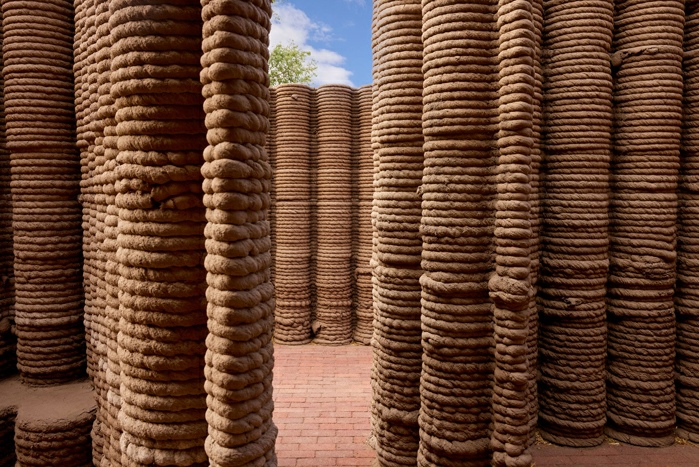
Ronald Rael, LIMINAL, 2026. 3D printed adobe. Courtesy of the artist. Photo: Brad Trone.
Exhibition 27 June 2026 -

© ArtCatalyse International / Marika Prévosto 2025 All Rights Reserved
Exhibition 27 June 2026 -